The future of the automobile isn’t that far away and part of that future encompasses cars that drive themselves. Volvo is at the forefront of that research and they have completed a research project using magnets in the roadway to help the car determine its position. While established positioning technologies such as GPS and cameras have limitations in certain conditions, road-integrated magnets remain unaffected by physical obstacles and poor weather conditions.
In parallel with the potential in the field of autonomous driving, road-integrated magnets open up a number of other possibilities:
- Incorporating magnet-based positioning in preventive safety systems could help prevent run-off road accidents.
- Magnets could facilitate accuracy of winter road maintenance, which in turn could prevent damage to snow-covered objects, such as barriers and signs, near the road edge.
- There is also a possibility of more efficient utilization of road space since accurate positioning could allow lanes to be narrower.
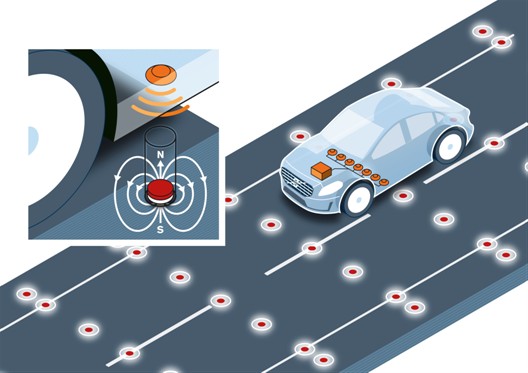
To test this Volvo Cars’ research team created a 100-metre long test track at the company’s testing facilities in Hällered outside Gothenburg, Sweden. A pattern of round ferrite magnets (40×15 mm) was located 200 mm below the road surface. The car was equipped with several magnetic field sensors. This was designed to evaluate crucial issues, such as detection range, reliability, durability, cost and the impact on road maintenance. The test results were very positive and have caught the attention of Swedish Transport Administration who co-operated with Volvo in this study. Expect to see a larger implementation on Swedish roads soon which will hopefully usher in a era of vehicles that drive themselves.
Hey IT Nerd! Are Tesla Cars Safe?
Posted in Commentary with tags Tesla on April 4, 2014 by itnerdI got this question in my inbox a few minutes ago:
Good morning. In your opinion, are Tesla cars safe? I heard that they had issues not too long ago when they struck objects on the highway. So I was wondering if that was ever properly addressed. Also, what is your overall impression of Tesla cars in terms of how they drive and what they offer?
Thanks very much.
Thank you for the question.
Tesla did have two instances of objects on highways puncturing the battery pack and starting a fire. One of those instances was captured on video. But there were no injuries in any of these cases and the occupants were never in any danger as the cars apparently directed the occupants to pull over and exit the vehicle. At the time I didn’t really think much of it. I’ll quote myself from the article that I linked to above:
Most people, meaning about 95% of us or more, drive cars with this highly volatile liquid called gasoline in the back end of the car. Imagine what would have happened if that exact scenario took place with a gas powered car. It would likely be catastrophic. Plus, it would likely not had made the news in the same way that this incident did. It would have been a non-event that wouldn’t have affected the stock price of whomever made the car. But because this is Tesla and we’re dealing with the hoopla that surrounds this company, this incident is a sensation and Tesla shares took a $2.5 billion haircut.
Now since this has happened, the NHTSA has reaffirmed the five star rating for the Tesla Model S. Plus they are adding titanium underbody shields to stop this from happening. Existing Model S owners can get these plates retrofitted and new cars will ship with them installed. Thus my perception is that these cars are perfectly safe.
Now to your second question. What is my overall impression of Tesla cars? I really can’t answer that in any fair manner. They look nice, and on paper they’re interesting. But beyond that, I cannot really say. I would really have to drive one and quiz someone about the ins and outs of their products. Much in the same way that I have done with Volvo, Mazda, Chrysler, or any other car that I’ve written about in the past few years. To do that properly, I would of course need the help of Tesla. I have reached out to Tesla Public Relations on several occasions both by voice and by e-mail and have never received a reply. Plus when I’ve gone into their dealerships here in Toronto, I perceive that the people in their dealerships are adverse to talking to people from the media without some sort of approval. Thus that story has never happened and as a result, I can’t answer your question and I apologize for that. Perhaps if someone from Tesla reads this, you can reach out to me and help me to answer this question for this reader. I’d appreciate it and I know this reader would as well.
Leave a comment »