Archive for April, 2014

BREAKING: Canada Revenue Agency Website Closed Due To Security Issues [UPDATED]

Posted in Commentary with tags , on April 9, 2014 by itnerd

News is breaking in Canada that the Canada Revenue Agency, the section of the government that handles income tax returns among other things has closed their website. CBC is reporting that it has to do with the OpenSSL bug that I reported yesterday. Now this comes at a really bad time for the Canadian Government as income taxes are due at the end of the month and everyone and their dog are filing their taxes online. Hopefully this gets resolved very quickly.

UPDATE: The CRA has posted this statement:

The Canada Revenue Agency (CRA) places first priority on ensuring the confidentiality of taxpayer information.

After learning late yesterday afternoon about the Internet security vulnerability named the Heartbleed Bug that is affecting systems around the world, the CRA acted quickly, as a preventative measure, to temporarily shut down public access to our online services to safeguard the integrity of the information we hold. Applications affected include online services like EFILE, NETFILE, My Account, My Business Account and Represent a Client.

We are currently working on a remedy for restoring online services and, at this time, anticipate that services will resume over the weekend.

The CRA recognizes that this problem may represent a significant inconvenience for individual Canadians who count on the CRA for online information and services.

Recognizing this, the Minister of National Revenue has confirmed that individual taxpayers will not be penalized for this service interruption.

We continue to investigate any potential impacts to taxpayer information, and to be fully engaged in resolving this matter and restoring online services as soon as possible in a manner that ensures the private information of Canadians remains safe and secure.

We will provide further information and daily updates at 3PM EDT on our home page.

Review: 2014 Volvo S60 T6 AWD – Part 2

Posted in Products on April 9, 2014 by itnerd

IMG_0885


The Volvo S60 T6 AWD is powered by a a turbocharged 3 litre inline six cylinder that generating 300 HP and 325 pound feet of torque. Now, frequent readers of this blog will know that when I tested the XC60 and the 2013 S60, I had this same engine with some software from Polestar installed which allowed it put out 325 HP and 354 pound feet of torque. So one must logically assume that this engine will be somewhat of a letdown after having all those extra ponies and torque at the disposal of my right foot. But it isn’t a letdown. Far from it in fact. There’s more than enough power here to put you into license suspension territory very quickly. Power delivery is instant, there’s little if any turbo lag, and torque which shows up for work at 2100 RPM just keeps building and building. Volvo claims a 0-60 time of 5.9 seconds. Something that was backed up by the app Dynolicious which I use to test these sorts of things. The power gets to the ground via Volvo’s Instant Traction All-Wheel-Drive system which can alter the torque from front to rear to make the car go forward as fast as possible and eliminate torque steer. It also includes torque vectoring which shunts power from side to side to almost eliminate understeer. The latter makes this car handle exceptionally well in turns. Speaking of handling, it’s very sharp and the car feels light on its feet and steering is direct and well weighted. The suspension is on the stiff side which helps with that. But I will note that speed bumps and roads with potholes (and there are lots of the latter in Toronto at the moment) will result in some “clunking” noises from the suspension. But it never makes it to your rear end which is good.

The S60 T6 AWD has a six speed automatic transmission that can be run in three modes:

  • Shift it to “D” and the transmission is very smooth. Except at very low speeds, I could not feel it shift at all.
  • If you slide the gear shift left so that it is set in “S” mode and leave it there, the transmission shifts on its own a more aggressively. In this mode, you can feel the car shift gears, but it is not objectionable.
  • In that left most position, you can shift it yourself by pushing the gear shift up or down, or by using the paddle shifters on the steering wheel. The latter addresses a criticism that I had about the 2013 S60. By the way, the paddle shifters work exceptionally well. Unlike some other vehicles that shifted gears slowly (because I was never really in full control of the transmission), this transmission shifted the instant that I pulled on the paddle shifters. Volvo tweaked the software that controls the transmission to deliver up to 30% faster shifts than the outgoing model. It’s very impressive for those who like to shift gears themselves. Another note, the paddle shifters work regardless of what position the gear shift lever is in which is something that you can’t do in every vehicle that has paddle shifters. That way you can hold a gear when you need it.

Other than tire noise and occasional wind noise, there’s nothing that makes it way into the cabin in terms of sound. Even engine noise is largely muted, unless you put your foot down. You can easily use the accelerator to crawl through stop and go traffic and on the open road you can deliver the right amount of power to get the speed you want. The brakes are easy to modulate and bring you to a stop smoothly. In terms of fuel economy, I’m averaging 13.1 L/100 KM at the moment. But that’s with very liberal use of the “go fast” pedal. That should improve as the week goes on.

The next part of the review will look at the interior which is in typical Volvo fashion, is exceptional in every way. Stay tuned for that.


Windows 8.1 Now Available

Posted in Commentary with tags on April 8, 2014 by itnerd

If you’ve been waiting for Windows 8.1, wait no longer. This post on WinBeta announced the news:

Windows 8.1 Update 1 has officially become available today. If you don’t already have it installed on your system — as it made a couple of unofficial appearances over the last few weeks, today Microsoft has officially made the update available for all. Furthermore, Microsoft is calling this update “mandatory” to all Windows 8.1 users.

It’s mandatory because users who do not upgrade will not get any future security updates after May 2014. I’ve detailed many of the changes here, so if you’re running Windows 8, download and install away. Then after you’ve tried it out, post a comment and let us know what you think. 

Windows XP Is Dead…. What Do You Do Now?

Posted in Commentary with tags , on April 8, 2014 by itnerd

So. Windows XP is no more. The question is what do you do if you are running XP? Here’s a list of three things you can do until you switch to Windows 7 or Windows 8:

  • Download and install every Windows XP patch that you can find. That’s because after today you want to make sure you’re up to date in terms of protecting yourself from any security issues. Plus after today, Microsoft won’t be offering any new patches for any issues that are discovered going forward:
  • Don’t use Internet Explorer. Instead, switch to Firefox or Chrome. That will buy you a year (as both browsers will end their support for XP sometime next year) and keep you safe (or at least mitigate) from any “drive by” threats you may come across when you surf the web.
  • Make sure your anti-virus software is up to date. Because with no new patches coming from Microsoft, that’s going to be your first line of defense from any threats.

Microsoft has a webpage that has more information on the risks and the like regarding staying with XP. Plus there’s another webpage on how to migrate to Windows 7 or Windows 8. I would recommend reading both of those. That way you can figure out what you need to do going forward.

Critical Flaw With Web Security Protocol Exposed

Posted in Commentary with tags on April 8, 2014 by itnerd

If you’ve ever used the web to do online banking or buy something online, you didn’t know it but your transaction was likely being secured using a protocol called OpenSSL. A lot of sites use it. And that’s going to be a problem as there’s a serious flaw in OpenSSL that puts you at risk. Here’s the bad news from ZDNet:
The flaw can potentially be used to reveal not just the contents of a secured-message, such as a credit-card transaction over HTTPS, but the primary and secondary SSL keys themselves. This data could then, in theory, be used as a skeleton keys to bypass secure servers without leaving a trace that a site had been hacked.

This bug not a problem with OpenSSL’s inherent design. It’s an implementation problem. That is to say it the result of a programming mistake. There is already a fix available for the problem for the 1.01 program in OpenSSL 1.0.1g. Work is proceeding rapidly for a pair of the 1.02-beta line.

That isn’t good. But the bad news doesn’t end there:

That’s bad enough. but what really has some operating system and security companies ticked is that OpenSSL and others were hard at work at delivering the patched versions that would have limited the problem’s possible use by blackhat hackers, CloudFlare, a Web security company, revealed in a blog posting details about the security hole and that they’ve fixed the bug. They appear to have used the methods described by OpenSSL. Unfortunately, for everyone else, these methods were not ready for broad deployment.

According to one senior security developer at a major operating system company, “The main problem with what CloudFlare did was that they jumped the gun before the FIRST AVAILABLE patches were available to users. You don’t open the door and wave a red flag before the patches are ready to go.”

That means every evil hacker is trying to exploit this now. That means everyone from Amazon to your bank is rushing to fix this or mitigate this. You as the end user can do nothing to protect yourself. That’s not a good place to be. Here’s hoping that everyone who is affected by this fixes this quickly once patches are available.

Review: 2014 Volvo S60 T6 AWD – Part 1

Posted in Products with tags on April 8, 2014 by itnerd

I have a very unique opportunity this week. I get to drive the Volvo S60 T6 AWD just months after driving the 2013 version. It’s unique because I will get a chance to see how Volvo improved on what was already a great luxury sedan. First, here’s a shot of the S60:

IMG_0874

I really like the styling direction that Volvo has taken. It proves that you don’t have to be polarizing from a design standpoint to have a car that stands out.

IMG_0872

What I noted immediately was the fact that the dual tailpipes are integrated into rear end of the car. That’s very similar to the XC60 T6 AWD that I drove recently and provides a better look when compared to last year’s S60 T6 AWD R-Design Platinum that I drove.

IMG_0875


The ten spoke wheel design is interesting…..

IMG_0876

…. And from a distance they really give the car a very cool look.

Volvo is aiming the S60 squarely at the BMW 3-Series, Lexus IS, Mercedes-Benz C-Class, Audi A4, and the Cadillac ATS among others. To find out if it has what it takes to go head to head with them, I’ll be posting a multi-part review that will cover the following sections:

  • Engine, transmission, handling, fuel economy, and driving comfort
  • Interior
  • Technology in the vehicle
  • Wrap up

So lets see if Volvo can make anyone else in the luxury sedan space nervous.


LINUX Suffers From Serious Encryption Bug

Posted in Commentary with tags , on April 7, 2014 by itnerd

Usually, LINUX users like to look derisively at those who use Windows and Macs and their security issues. And laugh about how secure they perceive themselves to be. Here’s an example of where that isn’t true. According to an article at Ars Technica, a major security bug faces Linux users, akin to the one recently found in Apple’s iOS and OS X. Here’s what the article says:

“The bug is the result of commands in a section of the GnuTLS code that verify the authenticity of TLS certificates, which are often known simply as X509 certificates. The coding error, which may have been present in the code since 2005, causes critical verification checks to be terminated, drawing ironic parallels to the extremely critical ‘goto fail’ flaw that for months put users of Apple’s iOS and OS X operating systems at risk of surreptitious eavesdropping attacks. Apple developers have since patched the bug.”

As the quote states, Apple has fixed this bug. However, LINUX users are at the mercy of many vendors of different versions of the operating system rather than having to deal with a single company. Thus one vendor might fix it, but others may not be so quick to do so. Red Hat, Debian, and Ubuntu among others have this bug. So one has to wonder what these companies plan to do to address this issues and how long will it take to do so.

Microsoft Announces Windows In The Car

Posted in Commentary with tags on April 6, 2014 by itnerd

Microsoft is clearly feeling some Apple envy as they’ve announced their own in car system that’s similar to Apple’s CarPlay. Here’s what The Verge had to say:

Microsoft has created a concept that it’s currently testing in real cars, and the idea allows Windows devices to mirror what’s shown on screen into a touch- and car-friendly interface. The current prototype uses the connectivity standard Mirrorlink, an alternative to Apple’s CarPlay system. Mirrorlink is currently used by Nokia’s Symbian phones and Sony’s Xperia Z handset, but it’s expected to gain broader support if infotainment systems start to use the standard more. Volkswagen, Honda, Toyota, and Citroen are all working on cars with Mirrorlink support, and aftermarket car radio manufacturers Alpine and Pioneer are backing it.

I find the inclusion of aftermarket companies Alpine and Pioneer are on board. That’s because CarPlay thus far is only available to those who buy new cars. If you want to upgrade your existing ride, you’re out of luck. At least so far. Before you line up to get your hands on Windows in the car, don’t hold your breath. No ship date has been announced unlike CarPlay which should see systems in new cars later this year.

Hey IT Nerd! Are Tesla Cars Safe?

Posted in Commentary with tags on April 4, 2014 by itnerd

I got this question in my inbox a few minutes ago:

Good morning. In your opinion, are Tesla cars safe? I heard that they had issues not too long ago when they struck objects on the highway. So I was wondering if that was ever properly addressed. Also, what is your overall impression of Tesla cars in terms of how they drive and what they offer? 

Thanks very much. 

Thank you for the question.

Tesla did have two instances of objects on highways puncturing the battery pack and starting a fire. One of those instances was captured on video.  But there were no injuries in any of these cases and the occupants were never in any danger as the cars apparently directed the occupants to pull over and exit the vehicle. At the time I didn’t really think much of it. I’ll quote myself from the article that I linked to above:

Most people, meaning about 95% of us or more, drive cars with this highly volatile liquid called gasoline in the back end of the car. Imagine what would have happened if that exact scenario took place with a gas powered car. It would likely be catastrophic. Plus, it would likely not had made the news in the same way that this incident did. It would have been a non-event that wouldn’t have affected the stock price of whomever made the car. But because this is Tesla and we’re dealing with the hoopla that surrounds this company, this incident is a sensation and Tesla shares took a $2.5 billion haircut. 

Now since this has happened, the NHTSA has reaffirmed the five star rating for the Tesla Model S. Plus they are adding titanium underbody shields to stop this from happening. Existing Model S owners can get these plates retrofitted and new cars will ship with them installed. Thus my perception is that these cars are perfectly safe.

Now to your second question. What is my overall impression of Tesla cars? I really can’t answer that in any fair manner. They look nice, and on paper they’re interesting. But beyond that, I cannot really say. I would really have to drive one and quiz someone about the ins and outs of their products. Much in the same way that I have done with Volvo, Mazda, Chrysler, or any other car that I’ve written about in the past few years. To do that properly, I would of course need the help of Tesla. I have reached out to Tesla Public Relations on several occasions both by voice and by e-mail and have never received a reply. Plus when I’ve gone into their dealerships here in Toronto, I perceive that the people in their dealerships are adverse to talking to people from the media without some sort of approval. Thus that story has never happened and as a result, I can’t answer your question and I apologize for that. Perhaps if someone from Tesla reads this, you can reach out to me and help me to answer this question for this reader. I’d appreciate it and I know this reader would as well.

Volvo Testing Road Magnets For Accurate Positioning Of Self-Driving Cars

Posted in Commentary with tags on April 4, 2014 by itnerd

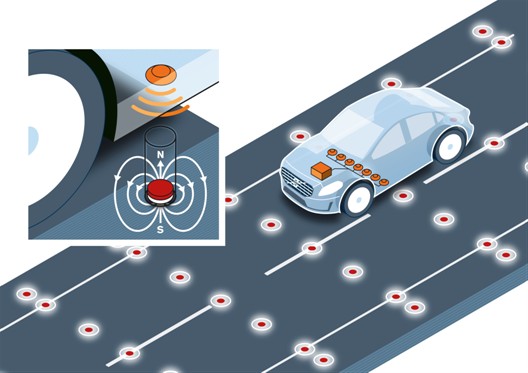
The future of the automobile isn’t that far away and part of that future encompasses cars that drive themselves. Volvo is at the forefront of that research and they have completed a research project using magnets in the roadway to help the car determine its position. While established positioning technologies such as GPS and cameras have limitations in certain conditions, road-integrated magnets remain unaffected by physical obstacles and poor weather conditions.

In parallel with the potential in the field of autonomous driving, road-integrated magnets open up a number of other possibilities:

  • Incorporating magnet-based positioning in preventive safety systems could help prevent run-off road accidents.
  • Magnets could facilitate accuracy of winter road maintenance, which in turn could prevent damage to snow-covered objects, such as barriers and signs, near the road edge.
  • There is also a possibility of more efficient utilization of road space since accurate positioning could allow lanes to be narrower.

2

To test this Volvo Cars’ research team created a 100-metre long test track at the company’s testing facilities in Hällered outside Gothenburg, Sweden. A pattern of round ferrite magnets (40×15 mm) was located 200 mm below the road surface. The car was equipped with several magnetic field sensors. This was designed to evaluate crucial issues, such as detection range, reliability, durability, cost and the impact on road maintenance. The test results were very positive and have caught the attention of Swedish Transport Administration who co-operated with Volvo in this study. Expect to see a larger implementation on Swedish roads soon which will hopefully usher in a era of vehicles that drive themselves.