Trend Micro Incorporated, today released a new report warning of a “darkverse” of criminality hidden from law enforcement, which could quickly evolve to fuel a new industry of metaverse-related cybercrime.
The top five metaverse threats outlined in the report are:
NFTs will be hit by phishing, ransom, fraud and other attacks, which will be increasingly targeted as they become an important metaverse commodity to regulate ownership.
The darkverse will become the go-to place for conducting illegal/criminal activities because it will be difficult to trace, monitor and infiltrate by law enforcement. In fact, it may be years before police catch up.
Money laundering using overpriced metaverse real estate and NFTs will provide a new outlet for criminals to clean cash.
Social engineering, propaganda and fake news will have a profound impact in a cyber-physical world. Influential narratives will be employed by criminals and state actors targeting vulnerable groups who are sensitive to certain topics.
Privacy will be redefined, as metaverse-like space operators will have unprecedented visibility into user actions – essentially when using their worlds, there will be zero privacy as we know it.
As imagined by Trend Micro, the darkverse will resemble a metaverse version of the dark web, enabling threat actors to coordinate and carry out illegal activities with impunity.
Underground marketplaces operating in the darkverse would be impossible for police to infiltrate without the correct authentication tokens. Because users can only access a darkverse world if they’re inside a designated physical location, there’s an additional level of protection for closed criminal communities.
This could provide a haven for multiple threats to flourish—from financial fraud and e-commerce scams to NFT theft, ransomware and more. The cyber-physical nature of the metaverse will also open new doors to threat actors.
Cybercriminals might look to compromise the “digital twin” spaces run by critical infrastructure operators, for sabotage or extortion of industrial systems. Or they could deploy malware to metaverse users’ full body actuator suits to cause physical harm. Assault of avatars has already been reported on several occasions.
Although a fully-fledged metaverse is still some years away, metaverse-like spaces will be commonplace much sooner. Trend Micro’s report seeks to start an urgent dialog about what cyber threats to expect and how they could be mitigated.
Questions to start asking include:
How will we moderate user activity and speech in the metaverse? And who will be responsible?
How will copyright infringements be policed and enforced?
How will users know whether they’re interacting with a real person or a bot? Will there be a Turing Test to validate AI/humans?
Is there a way to safeguard privacy by preventing the metaverse from becoming dominated by a few large tech companies?
How can law enforcement overcome the high costs of intercepting metaverse crimes at scale, and solve issues around jurisdiction?
With the school season approaching, parents hurry to get their children supplies while students enjoy their last days of summer.
However, barely anyone realizes that enterprises in the education sector are currently under a barrage of malware attacks. Data presented by Atlas VPN reveals that the education industry has been the primary target for cyberattacks in the last 30 days.
Over 80% of malware attacks globally were aimed at companies in the education sector, totaling 5.13 million attacks for the period, which comes out to an average of 171 thousand attacks daily.
The data for the analysis was extracted via Microsoft’s Security Intelligence platform.
One of the reasons why the education industry became the main target is the shift towards digitalization. The pandemic forced e-institutions to employ technologies that enable students to complete the curricula and exams.
In turn, a lot of new companies sprang up as they saw the opportunity in the market.
However, video conferencing programs, e-learning software, and other digital tools expanded the cyberattack surface exponentially.
It is worth noting that the aforementioned attacks are directed toward enterprises, not institutions. In other words, the data provided shows the number of attacks on businesses in the educational sector, not on schools, colleges, and universities.
Posted in Commentary with tags Slack on August 9, 2022 by itnerd
If you’re a Slack user, you might have received a request to change your password in the last day or two. I’m here to tell you that this email isn’t a phishing attempt. It’s actually real and you should pay attention to it.
Here’s why.
Slack has admitted to accidentally exposing the hashed passwords of at least 50,000 users, roughly .5% of total Slack users. The workspace application began sending password reset links to affected users last week. While the passwords were not in plaintext and were not visible to any Slack clients, it appears that this issue has been going since 2017.
#Fail.
Sharon Nachshony, Security Researcher, Silverfort had this to say:
“Hashes of salted passwords being leaked is not as dangerous as exposing them in plain-text, as an attacker would have to use brute-force methods – essentially automating a script to guess passwords – which takes some time.
While this makes exploitation less likely, a threat actor may still be motivated to do this because Slack is used by so many companies. Incidents like these are once again a clear argument for users to enable MFA. If implemented correctly, this would alert the legitimate user to any authentication attempt on their behalf, denying any malicious access attempt.”
MFA (Multi Factor Authentication) or even the new hot technology which is passwordless authentication is the way to go to reduce your attack surface. Companies should look at technologies like these to avoid being pwned because of a password exploit.
Posted in Commentary with tags Wise on August 9, 2022 by itnerd
Wise (LSE: Wise), the global technology company building the best way to move money around the world, today introduced the INTERAC e-Transfer Request Money feature, a new, more convenient way Canadians can move money into their Wise accounts. In collaboration with Peoples Payment Solutions, part of People’s Group, Wise customers can securely move Canadian Dollars between Wise and other financial institutions in Canada using their email address or mobile number with money typically available within 30 minutes.
As Canadians continue to seek out faster and more convenient payment options, Wise will continue to deepen its offering and build new features that meet the local needs of consumers and businesses in Canada.
In fact, Wise has already launched several offerings tailored to Canadians, including the following:
Launched the Wise card: In November, Canadians were introduced to the Wise card. A card that is up to 4x cheaper than banks for spending abroad, giving consumers and businesses the ability to spend in USD and foreign currencies without foreign transaction fees and the usual bad exchange rates that banks may charge.
Introduced Auto Conversions: In March, Canadians were introduced to a new way to save on a more favourable exchange rate through Auto Conversions. Set your desired exchange rate and Wise will convert your money for you when your desired rate is met in the market.
Enabled INTERAC e-Transfer Payouts: As part of Wise’s commitment to meeting the local needs of Canadians, Wise has already allowed customers who receive money into their Wise account to move funds out of Wise to another Canadian account using INTERAC.
To learn more about Wise and its universal account visit https://wise.com/ca.
By Hank Schless, Senior Manager of Security Solutions at Lookout
Technology has transformed the hustle and bustle of back-to-school season. According to a recent survey, 35% of school shopping is done online and 65% of those purchases are done from a smartphone. But what is convenient for some is also an opportunity for scammers to exploit consumers during a very busy time of year. The Better Business Bureau has issued a warning about back-to-school shoppers being targeted by online scams.
In honor of National Back to School Prep Day on Monday, August 15, Lookout, the leader in delivering integrated Security, Privacy, and Identity Theft Protection solutions, has provided immediate steps consumers can take to ensure a safe online shopping experience.
Stop Before You Click If you are not certain that a message is from a legitimate source, avoid clicking on links or attachments in emails, on websites, or on social media. Beware of deals that seem too good to be true.
Only Use Unique & Strong Passwords Immediately update any old passwords that have been compromised online. Enable two-factor authentication.
Install Security Software On Your Devices Security protection, like Lookout, will automatically monitor and identify scam URLs in email, text messages, and on the web and block you from threats that can do harm.
Darktrace, a global leader in cyber security artificial intelligence (AI), and HackerOne, the leader in Attack Resistance Management, have partnered to combine Darktrace PREVENT/Attack Surface Management™ technology with the continuous security assessment capabilities of the HackerOne platform. The partnership expands HackerOne’s OpenASM initiative and delivers on a shared vision with Darktrace to help organizations secure their digital estate through leading technology and a community of ethical hackers.
HackerOne recognized the need for an ASM partner that could enhance the asset discovery and reconnaissance efforts of HackerOne’s community of hackers. After an extensive technology evaluation, it selected PREVENT/ASM™, a set of AI-powered capabilities that perform reconnaissance on a target attack surface simply by knowing the name of an organization or brand and identifying threats external to that target. The combination of AI and security expertise will deliver continuous insight and help organizations find and eliminate blind spots across their digital landscape before attackers can exploit them. To assure ongoing security improvement, Darktrace and HackerOne will collaborate to train hackers on ASM best practices as they find, enrich, and risk rank assets.
The Darktrace and HackerOne partnership helps organizations close their security gap. Organizations face challenges with an attack resistance gap between known digital assets and those they need to protect. According to The 2022 Attack Resistance Management Report, one-third of organizations said they monitor less than 75% of their attack surface, and almost 20% believe that over half of their attack surface is unknown or not observable. In June, HackerOne launched OpenASM, an initiative that empowers organizations to combine external scan data from ASM products with HackerOne’s proactive security testing capabilities to gain a comprehensive understanding of attack surface risks. As an early champion of OpenASM, Darktrace assures that customers can quickly gain visibility of their external assets, while hacker expertise provides targeted testing and data enrichment to address the most critical risks to their organization.
Are you heading to the Black Hat USA conference on August 10-11 at the Mandalay Bay Hotel, Las Vegas? Stop by Darktrace’s Booth #1132 or HackerOne’s Booth #2520 to see a demonstration of Darktrace and HackerOne’s products working together.
Infosec Institute, a leading cybersecurity education provider, today announced free cyber education resources to help organizations and employees level up their cybersecurity during National Cybersecurity Awareness Month (NCSAM) and beyond. Hosted every October by the Cybersecurity and Infrastructure Security Agency (CISA) and the National Cyber Security Alliance (NCSA), NCSAM aims to raise awareness about the importance of cybersecurity and provide resources for individuals to be secure online.
In support of this initiative, Infosec is providing a comprehensive security awareness and training toolkit, featuring:
A training module for employees of all levels
An employee assessment to help identify security awareness training needs
Four posters, newsletter and email templates focused on key security behaviors
An NCSAM-themed screensaver to educate learners on data breaches that happened this year
An employee presentation about the program and targeted behaviors
As National Cybersecurity Awareness Month approaches, Infosec will release additional complementary resources for use by organizations, including a hands-on skills challenge, a training webinar for security awareness administrators, and discounts on instructor-led boot camps. All Infosec NCSAM resources are powered by the award-winning Infosec IQ and Infosec Skills security education platforms. Infosec IQ security awareness and training empowers employees with the knowledge and skills to stay cyber-secure at work and home with over 2,000 awareness and training resources.Infosec Skills helps cyber professionals upskill and get certified with unlimited access to 1,200+ hands-on cybersecurity courses, labs and cyber ranges.
Posted in Commentary with tags Telus on August 8, 2022 by itnerd
TELUS is celebrating youth across Canada by launching the Friendly Future Makers Awards, inviting Canadians to nominate the Friendly Future Maker in their life who is creating long-lasting change in their community. Canadians can nominate a Friendly Future Maker aged 13-19 at telus.com/YouthAwards. Nominees will be entered to win one of six prize packs worth $7,000, which includes $5,000 for an RESP or to help fund their initiative, a $1,000 TELUS gift card, and a $1,000 donation to the registered charity of their choice. Inspired by TELUS’ long standing promise, Let’s make the future friendly, this nationwide callout continues that momentum and helps empower Canadian youth who are helping make the world a better place. The Friendly Future Makers Awards are open for nominations until September 26, and winners will be announced online October 24.
As the global leader in social purpose, TELUS is using its technology to address some of today’s most pressing challenges, including building the local health and well-being of communities, bridging digital divides and actively addressing climate change. To continue to drive meaningful, innovative change, one winner will be chosen, by a panel of judges, from each of the TELUS’ social purpose focused categories:
Connection Enabler – helping build human connections through being a mentor or volunteering at a local seniors home
Community Builder – giving back to those who need it most by volunteering in your neighbourhood or through small acts of kindness
Health & Wellness Helper – caring for the mental and/or physical health of your community through care packages or checking in on your neigbours
Hunger Hero – helping to feed communities through neighbourhood gardens or food drives
Planet Protector – giving back to protect the planet through picking up litter or recycling
Future Friendly Maker – creating change in your community to make the future friendly, outside of the five categories or across multiple categories
The Friendly Future Makers Awards are just one of many ways TELUS is continuing to invest in youth. Helping create meaningful change by bridging digital divides, TELUS’ Connecting for Good programs provide subsidized or free Internet and mobility services, helping ensure that youth from care, as well as children from low-income households can stay safely and reliably connected to the people, resources and tools that matter most. TELUS Wise, a free digital literacy program, offers informative workshops and resources helping more than 525,000 Canadians – including youth from across the country – stay safe in our digital world, while TELUS Friendly Future Foundation and TELUS Community Boards also fund more than 500 charities annually focused on helping Canadian youth thrive in a digital world.
Since 2000, TELUS has been a global leader in social capitalism, committing $1.4 billion to support charities and grassroots community organizations around the world, while also volunteering 1.8 million days of service. Each year, TELUS supports more than 4,000 charities and community organizations worldwide.
To learn more about the Friendly Future Makers Awards and to nominate an inspiring youth giving back in your community, visit telus.com/YouthAwards.
Posted in Products with tags Bell on August 8, 2022 by itnerd
Since I made the switch to Bell Internet, I’ve received a number of requests to review it. And also to review it against Rogers Ignite. Thus I will be doing so today. But I have to put a caveat out there first: This isn’t an Apple’s to Apple’s comparison. Let me explain:
In the Toronto area, the majority of Rogers customers are on what Rogers calls “Hybrid Fibre” which is their term for a fibre optic backbone, but the last mile delivered by copper wire. Contrast that with Bell where the majority of their customers get FTTH or fiber to the home. Meaning it is fibre from end to end. Why does that matter? The latter is way faster than the former as I will illustrate shortly.
I also mention the Toronto area because the tech that telcos have available to customers can vary greatly depending on your location. Copy and paste that for the price and the speeds that are on offer as well. For example in some places, like New Brunswick for example, Rogers does actually offer FTTH. And they are rolling it out in some other places as well. Though I have yet to come across it in my travels. And in parts of Quebec, FTTH rollouts from some telcos don’t reach the speeds that Bell or Rogers is doing in Toronto.
All of that means is that I can only compare the Bell and Rogers products that are on offer in the area of Toronto that I live in. Your experience wherever you are reading this from will vary.
So with that out of the way, here’s what I will be comparing today. The Bell Fibe 1.5 Gbps down / 940 Mbps up Internet offering will go up against Rogers Ignite 1 Gbps down / 30 Mbps up Internet offering. Now some of you are going to say that this isn’t a fair fight as Bell Fibe is going to utterly destroy Rogers Ignite. And you’re right. Bell Fibe does utterly destroy Rogers Ignite because Bell’s upload speeds make this an unfair fight as Rogers Ignite isn’t capable of doing anywhere near those sorts of speeds. But there’s more to it than that. Let’s start with a speed test from Rogers Ignite via my Asus ZenWiFi XT8 mesh router which was connected to Rogers Ignite modem (click to enlarge):
Ignore the raw speeds, which by Rogers standards are impressive as I’m getting 1.2 Gbps down which is above what Rogers promises. I want you to focus on the ping times and jitter. The ping time is sub 10ms which is good for consumer Internet. But the jitter which is a measurement of the variation or inconsistency of your ping speed, or put another way how consistent your ping speed is. The lower the jitter is, the better your connection is and the better your gaming or video call experience will be. But for a point of reference, anything below 30ms is considered to be acceptable in the gaming world. Though pro gamers want jitter to be in the low single digits. In this case it seems to be pretty decent. Thus other than the laughable 29.87 Mbps upstream speed, this connection isn’t that bad.
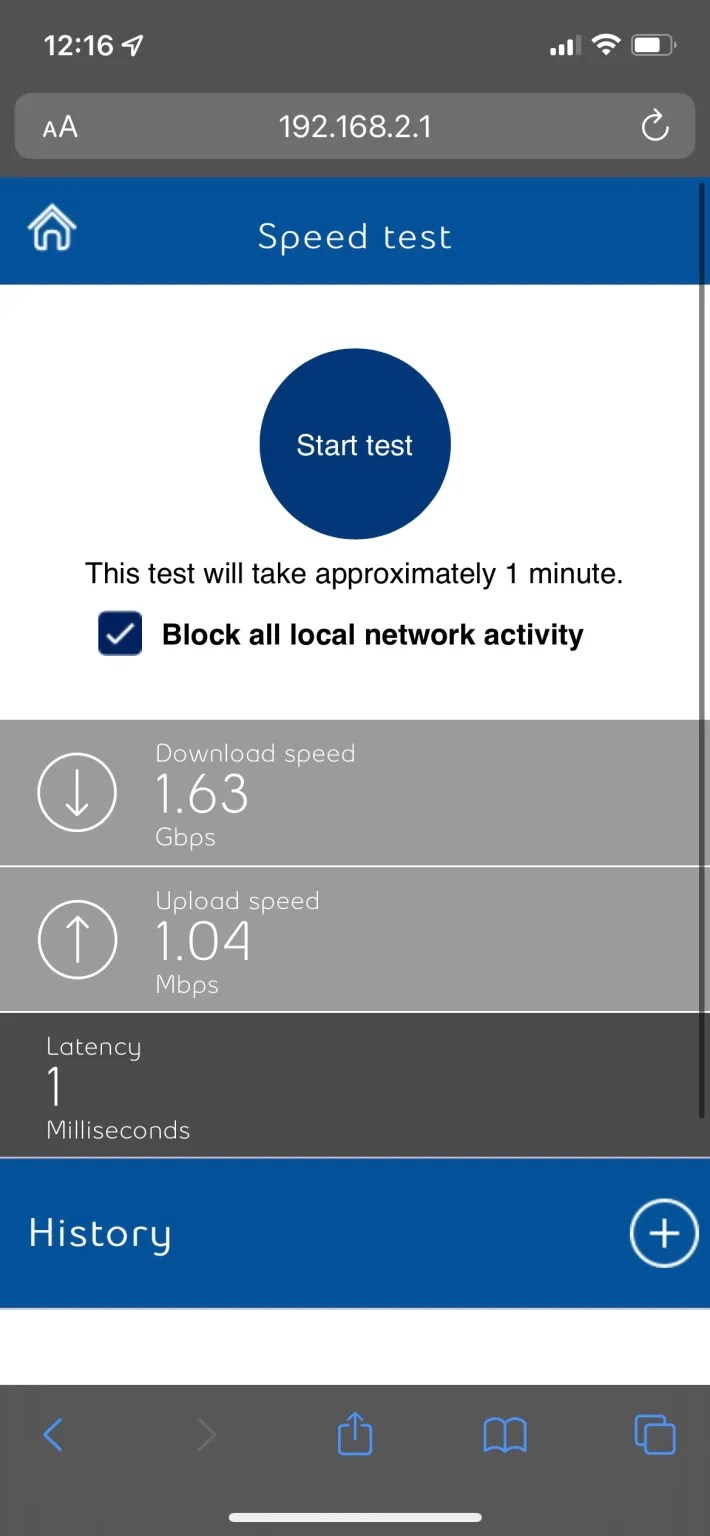
Now let’s look at Bell. Starting with the view from the Bell HH4000 modem which you get if you sign up with Bell Fibe:
So from the modem, I am getting more than I am paying for. And their “latency” of 1ms is likely the ping time. Which is great. However due to some issue with my ASUS mesh router that I am trying to figure out with the help of ASUS, I’m not getting all that speed on the upstream side of the connection of the router.
Even with this result, I want you to focus on the ping and jitter numbers again. The ping time is almost a fifth of what I was getting with Rogers. And the jitter is almost non-existent. The net result of that you can pwn n00bz in Call Of Duty Warzone with ease, or have a nice and fluid video call on Zoom or Teams. That’s the power of having an end to end fibre connection as it gives you a stable and low latency connection that was once only the domain of companies that could afford to get fiber run to their premises. I did additional testing on a few neighbours in my condo, all of whom have Bell Fibe Internet, and all of whom have different tiers of Bell’s Internet offering (more on those tiers in a moment), and the ping and jitter results were similar to mine. Thus I can conclude that regardless of what tier you choose, you’ll get high quality Internet.
One other thing that I will touch on before I get to what those tiers are is reliability. The same neighbours that I spoke to and tested their connections are in two camps. One camp are recent converts to Bell Fibe Internet because of the Rogers nationwide outage in July. And the other camp have had the service for a while. Some of them have had it from the day it was available in our condo development. None of them claim to have had any issues with the service. Many can’t remember an outage with Bell. While I will point out that past performance is not an indicator of future performance, hearing all of those comments suggests to me that Bell Fibe is reliable. Though time will tell on that front.
Now there is one thing that Rogers is better than be Bell at, and that is the deployment of IPv6 on their network. Or put another way, Rogers has IPv6 on their Ignite Internet offering and Bell doesn’t have it on their Fibe Internet offering. And Rogers has had it for years, effectively future proofing their network in the process. Given that we live in an age of smart phones, smart TV’s, the Internet of things, etc., the growing number of internet connected devices means that IPv4 is pretty much maxed out and telcos need to move to IPv6 as soon as possible. In fact, telcos should be on the IPv6 bandwagon by now. Which means that as it’s 2022, Bell should have had IPv6 on their network long before now. I say that because most consumers may not care about IPv6 today. But in a year or two they will when their latest cool gadget doesn’t work properly because of the lack of IPv6 support on Bell Fibe. Which means that Bell really should get about fixing that. Like now.
So over to pricing. Bell has a number of tiers for their Internet offering:
Now those are the list prices on Bell’s website for the area that I live in. Like I mentioned earlier, prices can vary depending on where you are and so can the speeds that are on offer. And on top of that, Bell’s incredibly aggressive customer service staff are all too willing to make you a deal if you get your Internet with more than one service. In my case, I was originally going to get home phone and 1Gbps Internet and the price was going to be about $50 cheaper than Rogers at $167 a month. But I got a deal that cut that to $114 or so a month via a variety of discounts that are time limited. Though they snuck in the Fibe TV app into the deal to do that. You can get the full details on my experience here. But let me get to the point. Bell’s customer service reps are insanely aggressive and walk up to the line of what I believe to be ethical behaviour in order to get you to subscribe to more services with Bell. This behaviour by these customer service reps, whom I am pretty sure are working for outsourced overseas call centres, is sure to turn some people off. For example, when my wife and I tried to switch to Bell a year ago, their behaviour was so bad that it sent us running back to Rogers. Though that was only for one more year and ended when Rogers recent troubles started. And when we did switch a couple of weeks ago, we were forced to run the gauntlet of Bell’s customer service reps upselling us to death. None of this helps Bell’s public image in any way as a lot of people have said to me that Bell’s tech is great, but Bell’s customer service sucks. If I were Mirko Bibic the CEO of Bell, I’d be figuring out how to fix that as their Internet offering is enough to win customers over by itself without having to resort to the borderline used car salesman tactics that are used by their customer service reps. And while I am at it, I’d also suggest that you avoid ordering via the website as according to a pair of Bell reps that I talked to, about 50% of the time the order doesn’t go through and customers never get their orders fulfilled leaving them angry. Which is mind blowing as that would be a great way to not have to talk to their reps and still get service from Bell. Though the cynic in me says that it’s a strategy by Bell to get you to call in and talk to their reps. Either way, this too needs to be fixed. You might want to get on that as well Mr. Bibic.
The bottom line is this, and some of this will sound familiar if you have read this article that I wrote several years ago. Bell has a top shelf Internet offering. It’s fast with low latency, and they keep pushing the pace in terms of speed and availability. If they clean up the way they sell their Internet offering, and implement IPv6, they will have an Internet offering that nobody (ahem Rogers) can stop.
I’ve gotten a few emails asking me to explain in detail why I feel that one should never, ever use the gear supplied by your ISP. The reason why I feel this way is multi-faceted. Let me walk you through the logic behind why I feel this way starting with the above statement.
Telco Lock In: Telcos are all about ARPU or Average Revenue Per User. And the best way to do that is to supply the gear that you need to use their Internet product. Bell does that, Rogers does that, everybody does that. Average consumers are happy to get this gear from their telco as the don’t have to go to Best Buy to figure out what router to buy, and they get tech support from the telco. It all sounds great until they want to switch telco’s. And that means trying to figure out how to set up all your smart home gear, you computers, your Xbox, and everything else on the new telco’s gear. For a lot of people, that’s enough to dissuade them from switching. Thus they’re locked in and the telco continues to get paid.
Security – Part 1: Security is the next thing. Telco’s aren’t known for spending the time, effort, or money into making sure their products are secure unless they are forced to. Which is another way of saying that a security issue appears and it embarrasses them into doing a fix. Contrast that with ASUS, Linksys or some other router company who typically spends a lot more time, effort, and money to make sure that their products are secure as a security issue that slips through could be business ending for them. While router companies aren’t perfect, they are a whole lot better than your telco when it comes to security.
Security – Part 2: Then there’s what the ISP can do via the gear that they supply to you. Every telco has access to the hardware that they supply you. Which means that they can potentially have access to what’s behind that gear. In other words, your network and what’s on it. That should really concern you as you are one rogue telco employee away from getting pwned.
Telco Supplied Gear Often Doesn’t Have The Same Level Of Functionality: When I say that ISP gear doesn’t have the same level of functionality, I mean telco gear is purpose built to get you online and perhaps support other services like landline phone and TV. And it often lacks the level of customization that you might need for specific applications. For example, if you work from home and your company supplies you with a SIP phone that connects to your employer’s phone switch, you may need to do some extra configuration to make that work. And your telco’s gear may not have that level of customization to make that happen. Or another example is the WiFi that your telco’s gear might have may not have the same speed or power of a router from ASUS or Linksys. Which means that if you have a large house or you want fast WiFi speeds, you’re out of luck.
So, how can you avoid all of this? You can use your own router and connect that to the telco’s gear. Just choose your router carefully and you can be assured that you’ll get the security and reliability that you need. And setting this up while not dead easy, is not all that difficult. Rogers for example has support for bridge mode in their hardware. They don’t like talking about it, and they don’t like it if you use it if you phone into their tech support, but it’s there. Bell has PPPoE passthrough that accomplishes something similar. Whatever your telco offers, you should use it. The advantages are:
You avoid telco lock in by making it easier to switch telcos as it can be as simple as unplugging a cable, or at most you unplug a cable and reconfigure your router. And you don’t need to “blow up” your network and it from scratch. This is because you reduce your telco’s gear to something that simply supplies your Internet connection. In other words a modem and nothing more. When I did this during my recent switch from Rogers to Bell, here’s what I did:
Unplug the Ethernet cable to my ASUS ZenWifi AX XT8 mesh router from the Rogers modem.
Plug the Ethernet cable to my ASUS ZenWifi AX XT8 mesh router into the Bell modem.
Log into the ASUS ZenWifi AX XT8 mesh router and change my WAN (wide area network) settings to PPPoE which is what Bell support from DHCP which is what Rogers supports.
Enter my PPPoE login name and password, click apply, and watch the router connect to the Bell network.
Done in 2 minutes and time to declare victory. And if it wasn’t just before 10AM when I was doing this, I would have had a beer too. Now I did do some other stuff, but this was the minimum that I had to do to get online.
You get better security on multiple fronts as your own router is going to be more secure as long as you keep on top of firmware updates, and your telco can’t access your gear as they can only see their own gear and the firewall in your gear will stop them in their tracks.
You get much higher levels of functionality.
Thus if you’re stuck on your telco’s gear, you should really consider getting off that train by using your own hardware to connect to the telco’s gear. Now I know that this might be a challenge for some people, which is why if you have any questions, leave a comment or email me and I will be happy to answer them.


Beware The Darkverse And The Cyber-Physical Threats It Will Enable: Trend Micro
Posted in Commentary with tags Trend Micro on August 9, 2022 by itnerdTrend Micro Incorporated, today released a new report warning of a “darkverse” of criminality hidden from law enforcement, which could quickly evolve to fuel a new industry of metaverse-related cybercrime.
The top five metaverse threats outlined in the report are:
As imagined by Trend Micro, the darkverse will resemble a metaverse version of the dark web, enabling threat actors to coordinate and carry out illegal activities with impunity.
Underground marketplaces operating in the darkverse would be impossible for police to infiltrate without the correct authentication tokens. Because users can only access a darkverse world if they’re inside a designated physical location, there’s an additional level of protection for closed criminal communities.
This could provide a haven for multiple threats to flourish—from financial fraud and e-commerce scams to NFT theft, ransomware and more. The cyber-physical nature of the metaverse will also open new doors to threat actors.
Cybercriminals might look to compromise the “digital twin” spaces run by critical infrastructure operators, for sabotage or extortion of industrial systems. Or they could deploy malware to metaverse users’ full body actuator suits to cause physical harm. Assault of avatars has already been reported on several occasions.
Although a fully-fledged metaverse is still some years away, metaverse-like spaces will be commonplace much sooner. Trend Micro’s report seeks to start an urgent dialog about what cyber threats to expect and how they could be mitigated.
Questions to start asking include:
To read a full copy of the report, Metaverse or MetaWorse? Cyber Security Threats Against the Internet of Experiences, please visit: https://www.trendmicro.com/vinfo/us/security/news/cybercrime-and-digital-threats/metaworse-the-trouble-with-the-metaverse.
Leave a comment »